 ClarityArc Vision
Portfolio management, as a practice.
Most portfolios don't fail for lack of a tool. They fail because intake, funding, delivery, and value live in different spreadsheets that never agree. The fix is a discipline — five stages, each with a clear owner, a clear gate, and numbers that carry through to the next.
1. Intake — one front door, and only three questions
Every request enters the same way: what do you need and why does it matter, when do you need it and what happens if it doesn't happen, and roughly what might it cost — with how firm that number is. Nothing else. Long intake forms don't produce better decisions; they produce workarounds, and the work that bypasses intake is exactly the work that surprises you later. In Vision the requester answers three questions and is done; classification, scoring, and strategy alignment happen at review, where they belong.
2. Prioritize — comparable scores, aligned to strategy
A ranking you can't explain is a ranking nobody trusts. Score every request from the same few structured answers — investment type, value driver, urgency, risk — so any two requests are comparable and any score can be explained in one glance. Then align each investment to exactly one strategic objective. One, not several: money that rolls up to two objectives gets counted twice, and double-counted money is how portfolios lie to their boards. Unaligned work stays visible as a standing question, never hidden.
3. Fund — commitment is not cash
Mature portfolios separate three events that casual ones blur: the budget (the envelope for the cycle), the commitment (approving a specific investment), and the release (actually moving money, one-time or staged against gates). The release is where your portfolio meets the finance system — it carries the AFE or PO reference, because that's the record accounting reconciles against. Holds and cancellations return money visibly. Vision runs this whole ladder natively.
Read the funding discipline guide →
4. Deliver — budgets live where the money is spent
Once work is funded, the project owns its budget — refined by the people delivering it, with an estimate-confidence rating (High, Medium, Low) and a recommended contingency that is reported beside the budget, never added to it. Confidence should rise and contingency shrink as phases advance; a late-stage low-confidence estimate is a visible warning, not a private worry. Spend is recorded as cumulative actuals, so burn and variance are always one subtraction away.
5. Prove value — verdicts, not vibes
The question every executive eventually asks — did we get the value? — deserves a dated answer. When a project closes, schedule follow-up reviews at 3, 6, and 12 months. Each review records a verdict: achieved, partial, not achieved, or too early. Verdicts never overwrite each other, so the honest history survives. Overdue reviews surface on the portfolio dashboard until someone answers.
Read the proving-value guide →
The thread through all five: numbers that reconcile
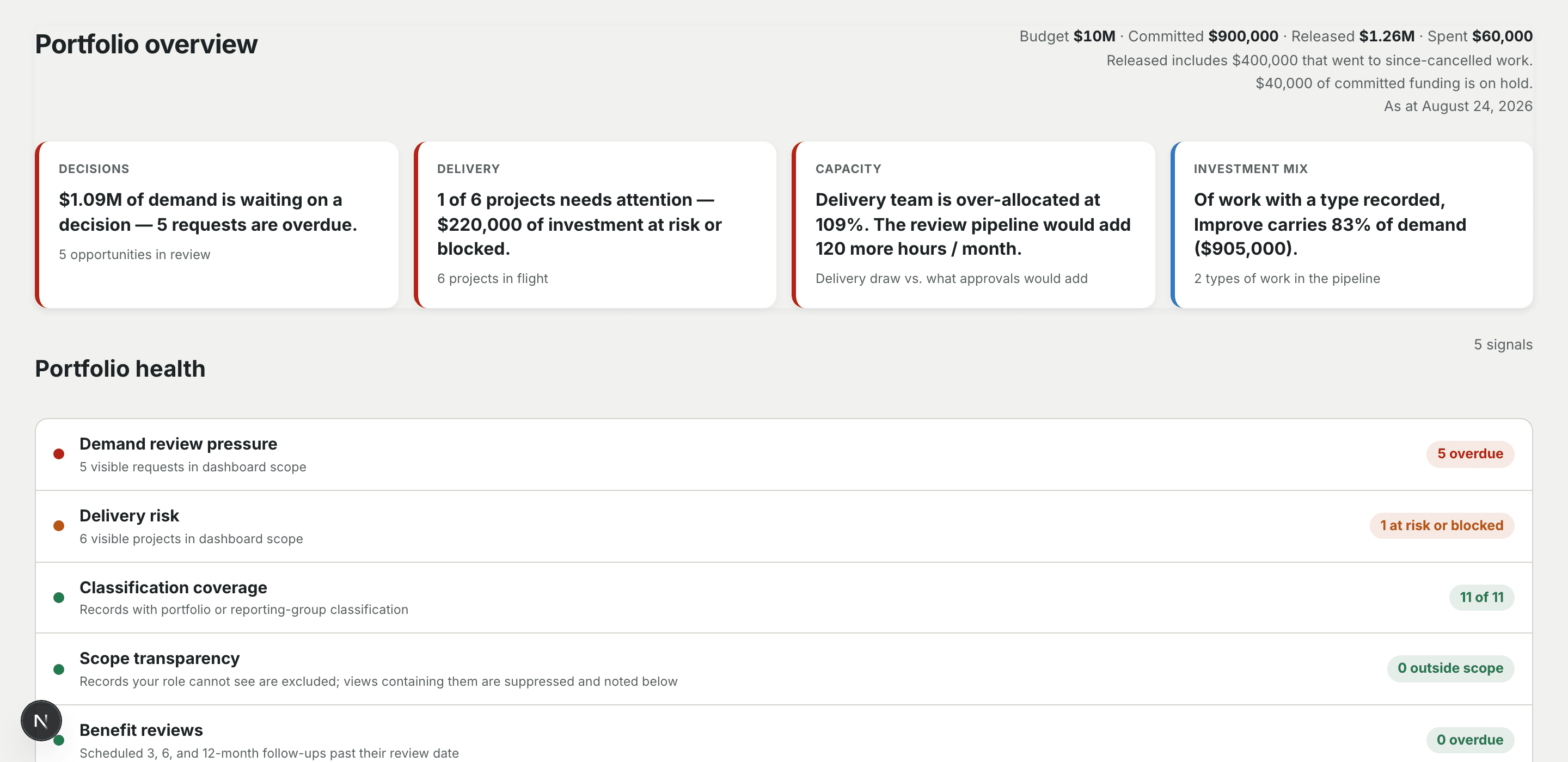
None of this works if the reporting on top of it contradicts itself. The standard is strict: every figure says what it counts, every pair of figures that should agree provably does, and anything hidden by permissions is disclosed rather than silently omitted. Vision enforces this mechanically — the same computation renders every surface, and an automated validator checks thousands of randomized portfolios on every release.
Read how trustworthy reporting is enforced →
Want to see it against your portfolio?
We will set up a workspace with your structure and walk you through it.