 ClarityArc Vision
The funding discipline: commitment is not cash.
The single most common source of portfolio distrust is a funding story that doesn't reconcile — approved here, spent there, and no transaction explaining the difference. The fix is a ladder with four rungs, where every adjacent pair either agrees or carries a visible explanation.
The four rungs
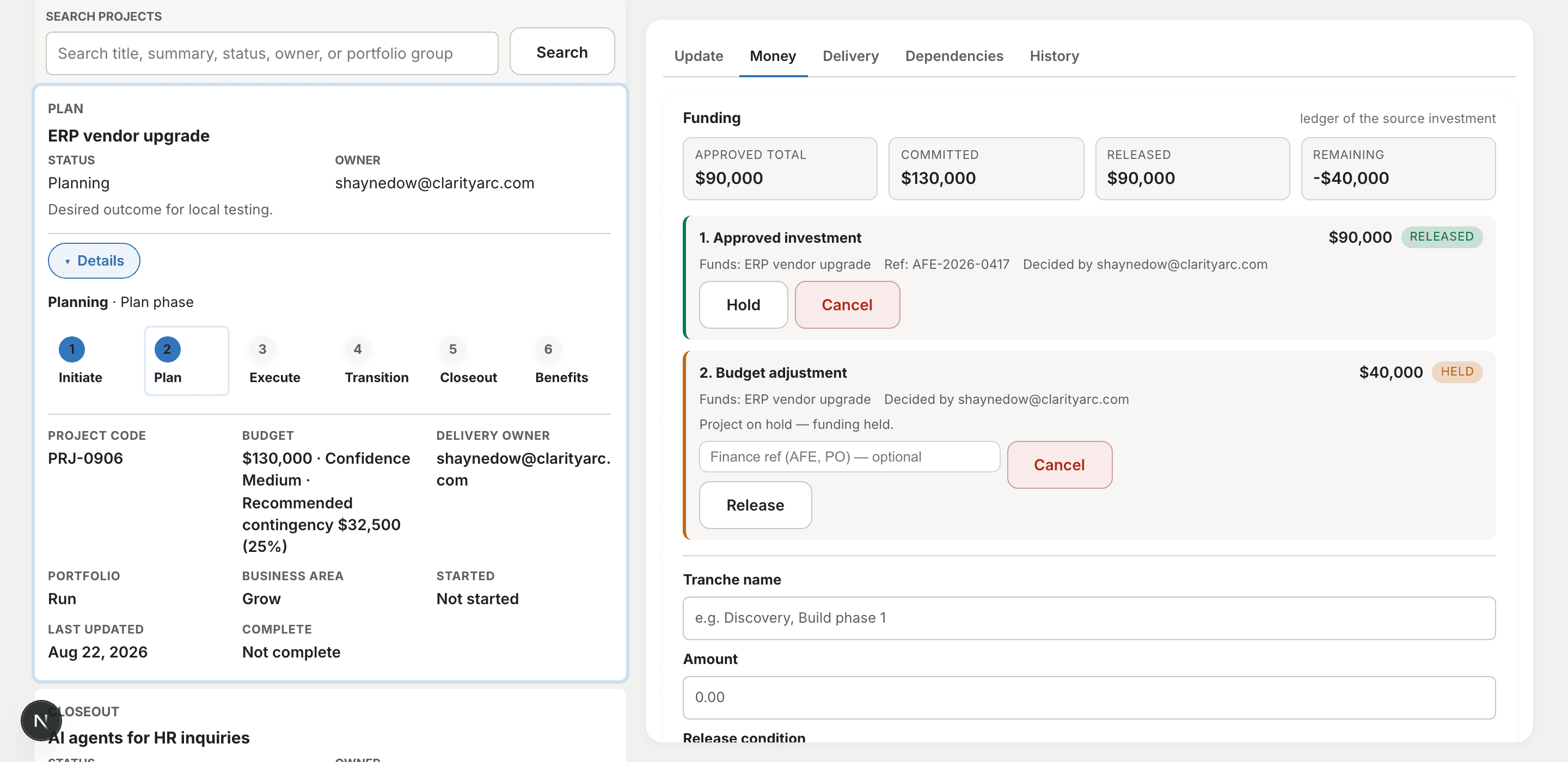
Budget is the envelope — set for the workspace in planning, adjusted per scenario when you model alternatives. Committed is what approvals have claimed against it: the moment an investment is approved, its money is committed, and the portfolio turns red the moment committed exceeds budget — that is the one red rule. Released is cash actually handed to delivery, one-time or staged against gates. Spent is cumulative actuals recorded against releases. Four numbers, three gaps, and each gap means something specific: unapproved headroom, staged funding not yet released, and released money not yet consumed.
Choose your release policy deliberately
Small portfolios often release the full amount at approval — simple, and honest as long as it is a policy rather than an accident. Larger portfolios commit at approval and release in tranches as gates are met: discovery funded now, build funded when discovery lands. Vision supports both as a workspace policy, and staged tranches survive conversion — your release schedule is never silently flattened.
The release is where finance meets the portfolio
Every release carries an external finance reference — an AFE number, a PO, an ERP project id — because the release event is the record accounting reconciles against. Capture it at the moment of release and the monthly reconciliation stops being archaeology.
Money returns visibly
A budget cut, a hold, or a cancellation must never strand money in the ledger. When a project's budget changes, the un-executed schedule is superseded and restated — released history is never rewritten. When a project goes on hold, its planned tranches are held: visible, not spent, not free. When a project is cancelled, unreleased funding is cancelled and the headroom returns to the envelope, while money already out stays on the record with the explanation attached.
Contingency is reported, never buried
Estimate confidence drives a recommended contingency — roughly 10% for validated estimates, 25% for working ones, 50% for rough guesses, in line with established estimate-classification practice. The contingency sits beside the budget in planning views; folding it into the budget hides your real exposure and quietly inflates every downstream number.
Want to see it against your portfolio?
We will set up a workspace with your structure and walk you through it.