 ClarityArc Vision
Proving value: verdicts, not vibes.
Every business case promises value. Almost no portfolio ever checks. The gap isn't bad faith — it's that checking has no owner, no date, and no place to land. Give it all three and the question answers itself.
Promise it at intake, in measurable terms
A benefit worth funding is a benefit you can measure: a name, a baseline, a target, and a unit. "Improve customer experience" is a hope; "cut onboarding from five days to two" is a benefit. Capture it when the investment is approved, because that is the moment everyone still remembers why the money moved.
The schedule creates itself
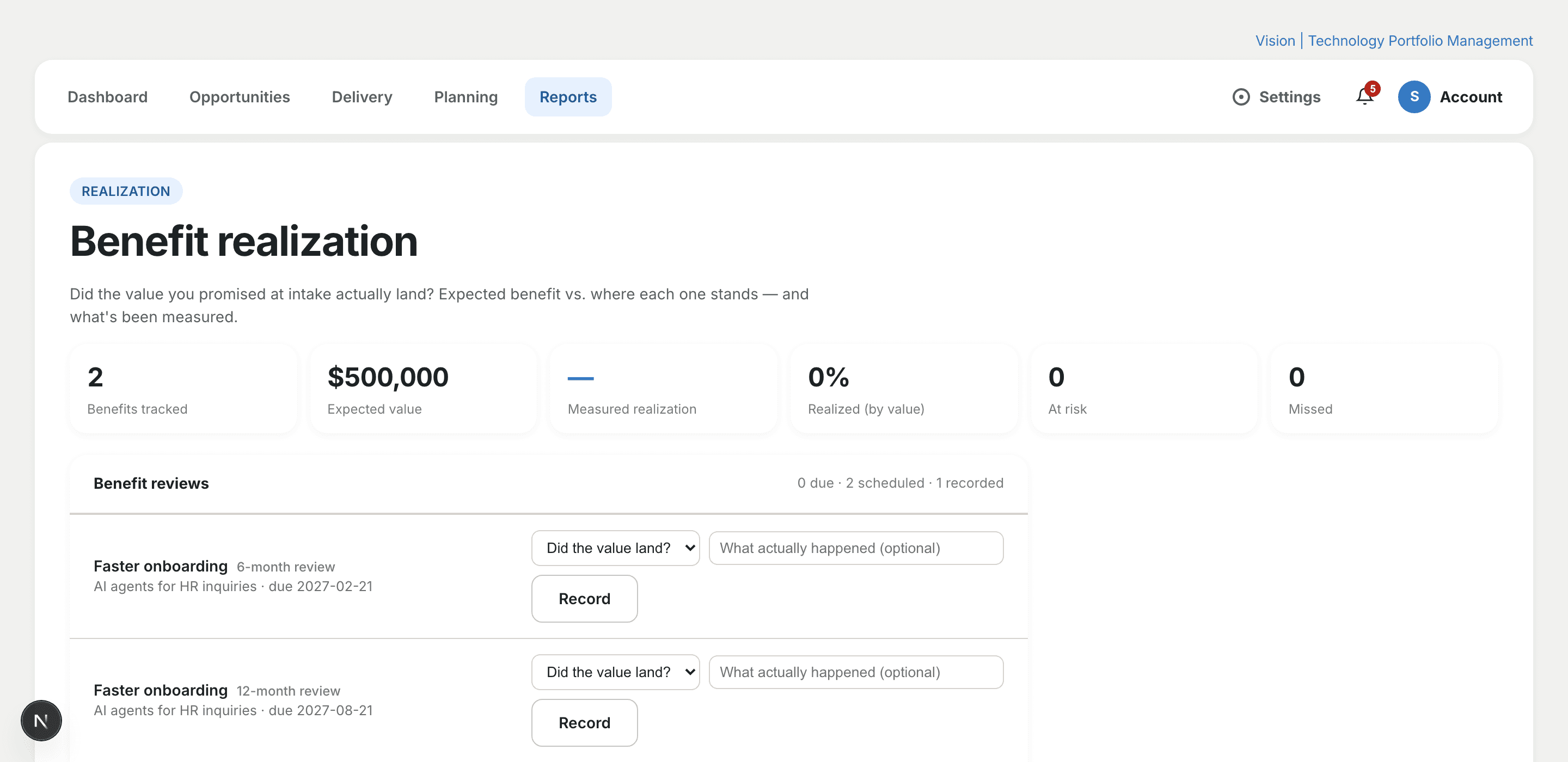
The standard cadence is post-implementation review at three months, again at six, again at twelve — long enough for value to land, soon enough that the people who did the work still exist. Nobody remembers to schedule these by hand, so don't ask them to: in Vision, closing a project automatically books all three reviews for every benefit it delivers.
Verdicts are dated and never overwritten
Each review records one of four honest outcomes — achieved, partially achieved, not achieved, or too early to tell — with a narrative. A verdict is a fact about a date, so it never overwrites an earlier one: the three-month "too early" and the twelve-month "achieved" are both part of the story. Rolling status fields can't do this; they only ever remember the last opinion.
Overdue reviews are a portfolio health signal
An unanswered review is a decision nobody made. Vision surfaces overdue benefit reviews on the portfolio dashboard beside delivery risk and demand pressure, and in the work queue of anyone who can record them — so "did the value land?" stops being a question that only gets asked in the post-mortem.
Want to see it against your portfolio?
We will set up a workspace with your structure and walk you through it.